
Thursday, March 31, 2011


Sunday, March 27, 2011
Miscellaneous

This is what many gardens look like in DC this time of the year. Daffodils, mulch, wintry ground cover, and stalks of greenery planted in the fall. And here are some more pictures of springtime in DC gardens. There are cob sheds, chickens, and early planting beds.


Finally, in the spirit of the movie festival just held in DC, here's a movie about Savannah, GA.
Sunday, March 20, 2011
Vanishing Bees

DC Environmental Film Festival is happening right now. There are many wonderful movies about many interesting topics playing all over Washington DC area, it is free, and I would recommend anyone to attend a few screenings. The movie that had a really great effect on me was "Vanishing of the Bees". There are two more screenings in DC, but if you're reading this from somewhere else in the world, there may be a screening near you, or you can request and organize one on their website. In DC the movie will be playing again on Thursday, March 24 at 7:30 PM at the Chevy Chase Presbyterian Church, and on Thursday, March 31 at 7:00 PM at Georgetown University (Hariri Building, Rm 160).
See it, and please visit a wonderful permaculture blog (with beautiful recent pictures of beehives) here.
http://www.vanishingbees.com/
http://www.dcenvironmentalfilmfest.org/
Sunday, February 6, 2011
Young Gardeners Wanted (Re-scheduled)

First ever workshop announced.
According to USDA Zone Map, Washington, DC is located in Zone 7, which means our average first freeze free date is April 15th. In the past I've planted anywhere from the middle of April to early June. I've also planted as late as August and September, but that's a different topic all together.
For early season planting in DC late April is a good ballpark to strive for. During the workshop we will discuss preparing the soil, supplementing nutrients with compost, basics of crop rotation, and designing an efficient watering system for a small urban garden. There will be actual planting and getting your hands dirty as well.
The workshop will be held in our garden in Mt. Pleasant on
I plan to start at 10 AM, and go for about two hours. It is free. Good things to bring are a trowel and gardening gloves.

Sunday, January 23, 2011
Building Soil

On a recent trip to Belize we took an excursion to the ancient Mayan city of Caracol. It is located so deep in the jungle that it takes 4 hours of driving and a military escort to get there. Among the amazing things we saw and learned there was the richness of jungle soil. The site is still being excavated, and one reason for that is the size of the ancient city, but the other reason is that at this point the jungle reclaims the city nearly as fast as it can be uncovered. Fences erected from twigs and branches grow roots and become jungle instead of fence. Avocado trees grow in the middle of plazas that have been clear cut to show how the city functioned in its time. The soil is so rich, you would be crazy to ever think about tilling it, whatever falls on the ground will sprout and grow. Soil like that should be the goal of every gardener; rich, diverse, full of nutrients and life.


When we started our garden in the city, we took over a small plot of land that has been taken care of somewhat. Our downstairs neighbor put a layer of newspaper down under the pavers to prevent weeds from growing. He just finished putting on a layer of top soil from the hardware store, and a layer of mulch on top of that, and there were a few flowers in the ground, and a few herbs in the pots. The condition of the soil was this: it was backfill from construction of the house sometime in the 1910’s, I pulled up many big rocks, cement chunks, plastics, and rebar from the ground (don’t know when and how those got there).
Step one is to get the soil tested. Depending on where you live, there are agencies or universities that do this. Oftentimes at a little cost which is completely worth it. Once you know that the soil is safe, and what it lacks you can go about treating it, and adding necessary nutrients, minerals, and fertilizers. Healthy soil is about balance. It needs to have the right balance of organic and inorganic matter, the right balance of nutrients, acidity, living creatures, etc. But you don’t need to be a scientist or learn chemistry; all you need to do is experiment and grow.
For example, if your soil needs more organic material, composting might be a good way to add some. We don’t compost with worms, although it’s really easy, can be done indoors, and provides a nutrient rich “product” that you can spray in your garden to replace some of the nutrients lost during the growing season. We have friends that do this, and they are kind enough to share.
Another way is to mulch. We usually mulch in the fall, this way the mulch doubles as a blanket for the soil in the winter, and has time to decompose and become one with the soil. This year a tree came down across the street, and the workers were kind enough to give us a few bins of wood chips from the back of the chipper. That was as local as it gets.
 |
| We used to look at this tree from our windows, we still do. |
If you need to introduce more calcium, use egg shells, phosphorus, add a bit of chicken manure. If your soil doesn’t have any critters, you can buy worms. They are sold in most gardening catalogues (they come in little spheres that contain 10 or so eggs, which will grow into worms) and will tell you exactly how healthy your soil is. If they live and prosper, you’re doing something right, if not, keep working.
 |
| Late season radishes. |
This is a good start.
Test your soil.
Start composting (either in a bin or with worms).
Mulch.
Use organic fertilizers. Never use chemicals, herbicides, or pesticides, as those kill everything, mostly things that are useful.
Rotate your crops.


Let’s hope we’re on our way to the unattainable goal of jungle soil.
Sunday, January 2, 2011
Pizza

For those who don't venture into pizza making the argument goes something like this:
If I pick up my phone and order pizza it will be here and ready to eat in about half an hour. If I make it myself, its closer to an hour and a half. (the dough takes 15 minutes to prepare, 1 hour to rise, and 15 minutes to bake) Who has the time?
Here's how I look at it. If you make it yourself from fresh ingredients it will be significantly better than anything that can be delivered. So the decision is, do you have something better later, or something worse now? Now about the time. Pizza dough keeps very well if it is covered in the refrigerator. If you have 15 minutes to spare one evening, or sometime over the weekend, that's all it takes to have the dough ready to use anytime you have a craving for pizza. Then it's a matter of pre-heating your oven, putting some ingredients on the rolled dough, and before you can set the table it will be ready to eat. Not bad, eh? Fresher, faster, and tastier than anything available in your neighborhood. Checkmate.
Simple dough recipe (from Joy of Cooking):
Combine in a large mixing bowl and let stand until the yeast is dissolved, about 5 minutes:
1 package (2-1/4 teaspoons) active dry yeast
1-1/3 cups warm water
Add:
3-1/2 cups all-purpose flour
2 tablespoons olive oil
1 tablespoon salt
1 tablespoon sugar (optional)
Mix by hand or on low speed for one minute, knead for about 10 minutes until dough is smooth and elastic. Transfer the dough to a bowl slightly coated with olive oil, cover, and let raise in a warm place for about an hour, or until its doubled in volume. Punch the dough down when it is done rising, divide into two, wrap it loosely in plastic and put it in the fridge. (the yeast will continue to do what yeast does, so if you do not let the dough rise completely, or wrap it too tightly, it will expand in the fridge and you will have a miniature version of the blob in there).
Sunday, December 26, 2010
Pickling

Making pickles is an excellent day project for late August when cucumbers are plentiful. With kitchen cleaning time, expect a 4-6 hour project for a dozen quarts.
DILL PICKLE RECIPE
(makes 3 quarts)
6-8 cucumbers, depending on the cut
2 quarts water
1 quart vinegar
1/2 cup salt
6 sprigs dill
6 cloves garlic, crushed with side of knife handle
Step 1: Clean
To avoid botulism it's very important to have clean surfaces. I washed the entire kitchen with bleach water.
Step 2: Veggie prep
Our garden did give us a season of fantastic cucumbers, however there were never enough at one time to undertake such a big project. So we supplemented with cucumbers from our neighborhood farmer's market. Look for canning-sized cucumbers. Small, green/yellow cucumbers are preferred. We opted for a variety of cucumber cuts: whole, spears, and whole with ends cut off. Wash the cucumbers and cut them as desired. Wash the fresh dill and cut into individual sprigs. Peel the garlic and crush the individual cloves with the side of the knife handle.


Step 3: Canning liquid
Combine the salt, vinegar, and water in a large pot. Bring to a boil.
Step 4: Prep canning jars
Wash the lids with warm soapy water. Boil the jars and rings for at least 3 minutes each. The boiling of the jars needs to be timed with the boiling canning liquid.
Step 5: Fill jars
Fill a freshly boiled (still hot) jar with cucumbers, 2 garlic cloves, and 2 sprigs of dill. Cover with boiling canning liquid to fill line. Place lid on top and tighten the ring. Set the jar aside and wait for the satisfying pop of the lid. Continue this process until all jars are filled. Lids should pop closed within the hour. Group the hot jars together, as they need the heat to seal. Let the jars cool over night.
Step 6: Final check


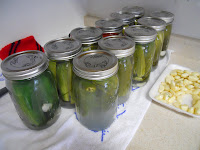


Making pickles is an excellent day project for late August when cucumbers are plentiful. With kitchen cleaning time, expect a 4-6 hour project for a dozen quarts.
DILL PICKLE RECIPE
(makes 3 quarts)
6-8 cucumbers, depending on the cut
2 quarts water
1 quart vinegar
1/2 cup salt
6 sprigs dill
6 cloves garlic, crushed with side of knife handle
Step 1: Clean
To avoid botulism it's very important to have clean surfaces. I washed the entire kitchen with bleach water.
Step 2: Veggie prep
Our garden did give us a season of fantastic cucumbers, however there were never enough at one time to undertake such a big project. So we supplemented with cucumbers from our neighborhood farmer's market. Look for canning-sized cucumbers. Small, green/yellow cucumbers are preferred. We opted for a variety of cucumber cuts: whole, spears, and whole with ends cut off. Wash the cucumbers and cut them as desired. Wash the fresh dill and cut into individual sprigs. Peel the garlic and crush the individual cloves with the side of the knife handle.


Step 3: Canning liquid
Combine the salt, vinegar, and water in a large pot. Bring to a boil.
Step 4: Prep canning jars
Wash the lids with warm soapy water. Boil the jars and rings for at least 3 minutes each. The boiling of the jars needs to be timed with the boiling canning liquid.
Step 5: Fill jars
Fill a freshly boiled (still hot) jar with cucumbers, 2 garlic cloves, and 2 sprigs of dill. Cover with boiling canning liquid to fill line. Place lid on top and tighten the ring. Set the jar aside and wait for the satisfying pop of the lid. Continue this process until all jars are filled. Lids should pop closed within the hour. Group the hot jars together, as they need the heat to seal. Let the jars cool over night.
Step 6: Final check
Just to avoid sickness, check that all the lids sealed. If the lid is not popped, it didn't work and should be discarded. For those that did seal, loosen the rings slightly (or remove altogether, if you prefer) and store the pickles for 6 weeks in a cool, dry place.
Six weeks later - enjoy!
Helpful hints: we placed a cotton dish towel at the bottom of the boiling water to help cushion the jars as they boiled and we removed the jars and rings from the boiling water with metal bbq tongs.
Helpful hints: we placed a cotton dish towel at the bottom of the boiling water to help cushion the jars as they boiled and we removed the jars and rings from the boiling water with metal bbq tongs.


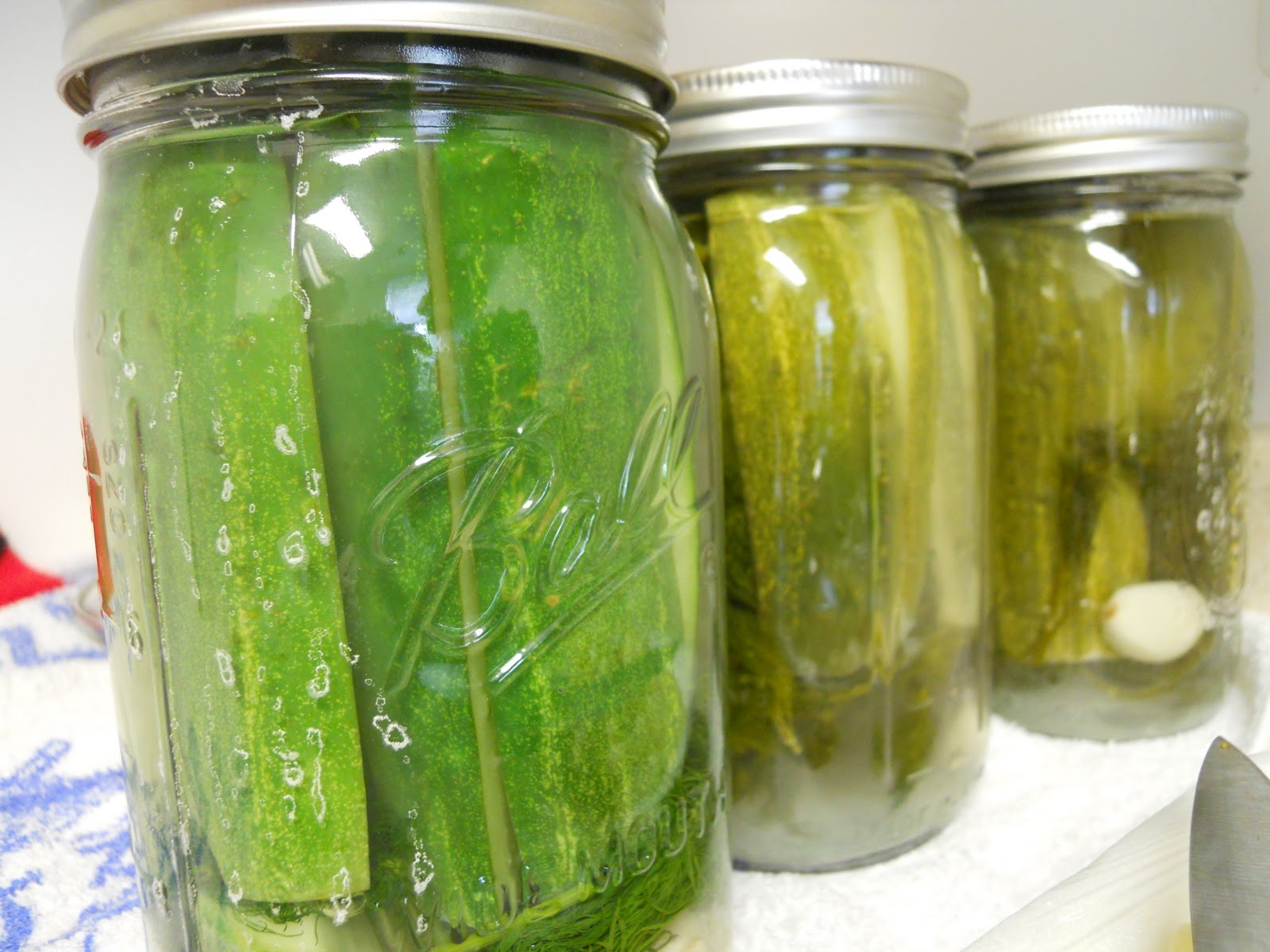

Big thanks to Annie and Christa for the pickles. And another one to Annie for the post.

Sunday, December 19, 2010
Fun with Hockey

If you're committed to something, it will touch everything else in your life. Let me explain. One of the places I enjoy spending endless time is in the garden in front of our row house. Another, is a hockey rink in the back of Francis Hammond Middle school in Alexandria. Seminary Rink is nestled in a wooded area surrounded by apartment buildings, parking lots, and soccer fields. Its right next to the highway, but you'd never know it's there, and good luck finding it, even with directions. On Sundays, when my team plays there, the school is packed with families, and the parking lots overflow with minivans. All the soccer fields are full of kids playing in their shiny, sharp-looking uniforms, and the rink is loud with the clatter of wooden sticks, cheers, and "what the f's". On a nice autumn day, some of us spend an hour at the rink, showing up for a game, and going home. Some stay the whole day, watch, referee, keep track of goals and penalty minutes. Sometimes I like to show up early and hang out for an hour or two before the game, watch hockey on tv behind the benches, talk to whoever is there, lean over the boards and watch the games, or just read a book. That's on a nice day.


Sunday, December 5 was not nice. It was a freezing evening, and there were three guys inside a car in a dark, quiet, empty parking lot, hesitant to go out in the cold.
'Where is Scott, I thought he'd be here?'
'I'm surprised he's not behind the shed sacrificing a chicken.'
This was the night of the championship game, and this was us waiting for our goalie to come so we could start warming up. Its not surprising, but we didn't wait in the car long, it doesn't matter how cold or dark it was, there was a hockey rink right next to us, and we were out there shortly. Some extra layers and pads, the lights were switched on, a few more teammates arrived, a few stretches, warm-up shots, sprints, and here comes the opening face-off.
One bad shift, and we're down. One good shift, and we're up. 2-1 Group Therapy at the end of the first. 3-1 at the end of the second. Our team moves from the bench to the penalty box in the third, but we get through it. One last kill. Game.


If you're committed to something, it will touch everything else in your life. If you want to know what I'm daydreaming about when I'm weeding the garden, it's scoring a game winner in OT. If you want to know where all the hockey sticks from Seminary Rink end up, that would be my garden. I guarantee you that all those sticks spend more time holding up tomatoes and cucumbers then they do at the rink.


Here is my favorite Jack Falla story, from the days when Wayne Gretzky began winning Stanley Cups in Edmonton:
"...As I headed out the dressing room door, Gretzky called me back.
'You shoot left?' he asked.
I said I did and he gave me one of his sticks. I appreciated the stick, but not as much as the question that suggested what Gretzky intended I do with that stick. The same thing he'd do. Use it. I caught a late morning flight home, and by mid-afternoon, I was out on the backyard rink using Gretzky's stick in a pickup game with kids from the neighborhood. It was a good stick. Light. Strong. It survived the backyard rink season and held together for a few games of spring driveway hockey before someone inevitably stepped on the blade, whereupon I threw it in a corner of the garage with all the other broken sticks. In June, I did the same thing with Gretzky's stick that I did with 23 other bladeless shafts. I hammered it into the soft ground of the garden and staked a tomato plant to it."

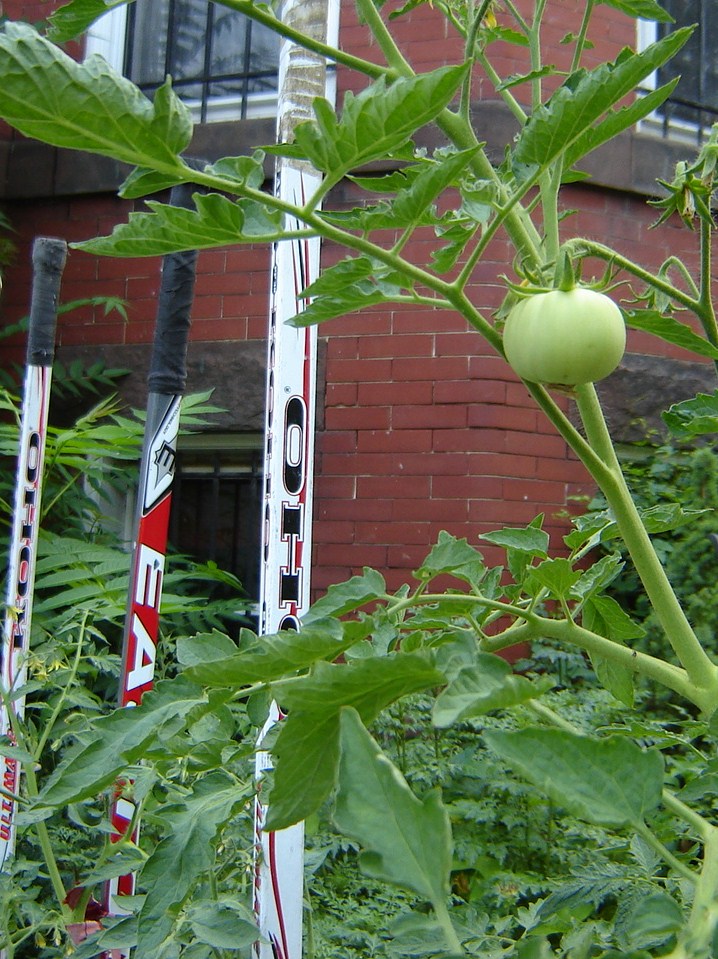
Yes, I do that too. I have many non-Gretzky sticks in the garden. When my parents visited DC for Cherry Blossom Festival, I couldn't go with them because a stick bruised my ankle and made it swell up. It isn't unusual for me to not be able to sleep on my back because a stick was jammed into my lower back during a game (guess I run too close to the net). I did score a game winner in OT once, and that stick is in the garden too. I just don't know which one is which.
 |
| Stanley Cup pumpkin from last Halloween |
Sunday, December 12, 2010
Composting

First let me tell you how easy it was to set this whole thing up. I bought a 32 gallon trash bin with a lid for about twelve bucks. With a drill, using a 1/4 inch bit, I cut drain slots all around the bin from bottom to top, as well as bigger drain holes in the bottom of the container, about 1 inch in diameter. All of this would take no more than a few hours, if your drill is even marginally better than mine. Placement is important. Obviously it doesn't have to be in the middle of the garden, taking land away from plants, or in plain sight of everyone in the neighborhood. Its not unsightly at all in my opinion, but as Dalton put it, opinions vary. So I thought it would be nice to be as considerate as possible to others, after all we all live in very close proximity in the city. Once I found a nice spot for it, by a brick wall in the corner of the garden, and not too close to the house itself, I dug a hole in the ground a bit less than 1 foot deep and set the bin in there. I transplanted some marigolds right around the bin, which covered and camouflaged it nicely, put some dirt at the bottom of the container to get it started, emptied the first load of kitchen scraps in there, and covered them with dry leaves. And here we go.


This was in late summer. Every once and again I turn the contents of the bin over with a shovel. From time to time I add water to the compost to help decomposition. And even though I have no idea if this is effective, sometimes I put cat hair into the bin after our cat is brushed. My thought is, the scent acts as an extra deterrent for the furry creatures that live all around us, but to my knowledge this has not been scientifically proven. Other than this, compost is on auto pilot, we empty out kitchen leftovers in there, and others in our row house do the same. We cover things that will decompose with things that are already dead, dry leaves, shrubs, cut up newspaper, and we wait for the spring when the first batch of decomposed organic material will be ready to go into the garden as fertilizer.
In our bin, we put almost everything that comes out of the kitchen in food preparation, not so much the table scraps. Onion peels, pepper insides, broccoli ends, potato peels, banana peels, celery ends, tea, apple cores, etc. No meat, no dairy. There is container with scraps in the fridge, and sometimes what used to be garbage, now lives in the freezer until its time to put it out. Its not that strange since I already keep all the egg shells in the freezer for months at a time, and also ask anybody from San Francisco what they have in their fridge since the whole city started composting, and you will see that a few leftover veggies next to your butter is not the end of the world. When it comes time to put things in the compost, we try to keep about 50/50 balance of green stuff (from the house), and brown stuff (from the outside, leafs, mulch, etc.).
So there it is. Compost. Almost no trash in the house, except a few recyclables, free fertilizer in the spring, free leaf cleaning service for our neighbors, and a cat warmer.
 |
| "Opinions vary" |
Sunday, December 5, 2010
Last Harvest

Everything was pulled today, plants, flowers, lettuce. We gathered leaves from our neighbors, and incorporated them into the soil for some mulch. A little fertilizer for the spring time as they decompose during the winter. We gatherer some more leaves and put them aside for the use in the compost bin later (I say "we", although I did very little of this physical labor, Annie and Saylor were responsible for most of this).

We also had four different kinds of lettuce growing in the garden since early Fall. Three were too bitter to eat, but one variety is very flavorful and will be the final crop we grew that will end up on the table this season. Some people grow lettuce in green houses outside all year round, but we just came back from many weeks of traveling and there was no time to build the little green guys a home before the freezing weather. So I guess we'll have to have lots of fresh salads this week.
Yes, there are some more plants like basil, and lettuce that will grow on our window sill through the winter, but as far as the out-door garden goes, this is it for 2010.
Coming up:
Composting, pickling, late season planting experiment, backyard garden design, masonry heating units, green house designs, cob construction.

Thursday, August 19, 2010
The Big Rain

It rained all day yesterday. A heavy, steady downpour, a kind of rain that took away August's humidity, like someone wrung out the whole big, wet blanket of summer in one day, and hung it out to dry overnight. Now everything is fresh, the air is cooler, the street air has a scent again. When you breathe, you inhale trees, leaves, and buildings, not the sultry steam of the pavement. When you feel something on your skin, its a breeze, a spider's web, not suffocating moisture. When walking outside, you notice the city, and the people instead of feeling miserable along with everyone.
I often think what this climate is like for the plants in my garden. I think how cold they are at night as little sprouts in April, and how strong they are to stand up to the downpours in May. I look at them from the window when the wind picks up in the evening, and if I wake up to a gust of wind outside I think of how they endure the weather, constantly, never having shelter. Tomatoes, baking in the hot sun, holding on to the moisture with their hairy stems and leaves. Cucumbers, gripping each other and their bamboo scaffolding as the rain washes away the soil under their leaves. Marigolds, sopping up all the water they can hold, taking in sunshine, and exploding with blossoms. Zucchini, swaying in the wind, loosing just a few giant leaves from the ends of their slender, water-filled stems.


If I spend a day outside in DC in this summer heat, I seek my air-conditioned bedroom in the evening, because all through the night, even as my body should be acclimated to the spongy heat, I won't be able to fall asleep with windows open in the sweaty, humid air around me. Meanwhile, the veggies outside have been doing it for almost their entire lives. From the first night they spent outside in April till now. As much as we liked the cool rain, it was really special for them. They all crawled through this miserable summer, and came out refreshed and rejuvenated after the downpour. They will be drinking this rain water for the next week, happily producing new flowers and fruit in the sun, and hopefully enjoy the next few days like the rest of us, without feeling like we're covered with a big, wet tarp.


Subscribe to:
Posts (Atom)